We are still not sure how they do it
A population of forty birds enters torpor inside a twenty minute window with no obvious signal passing between them. Four studies run here, and none of them have answered that yet.

Synchrony in Drowse onset
Forty birds enter torpor inside a twenty minute window, and after six seasons we still cannot say what tells them to.
Since 2016
- What is measured
- Onset time per bird against light intensity at canopy height, air temperature, last feeding time, and position in the range. Recorded every afternoon the building is open.
- What is still unknown
- Whether there is a cue at all. The simplest explanation left standing is that there is no signal and every bird independently arrives at the same state at the same time because it ate at the same time.
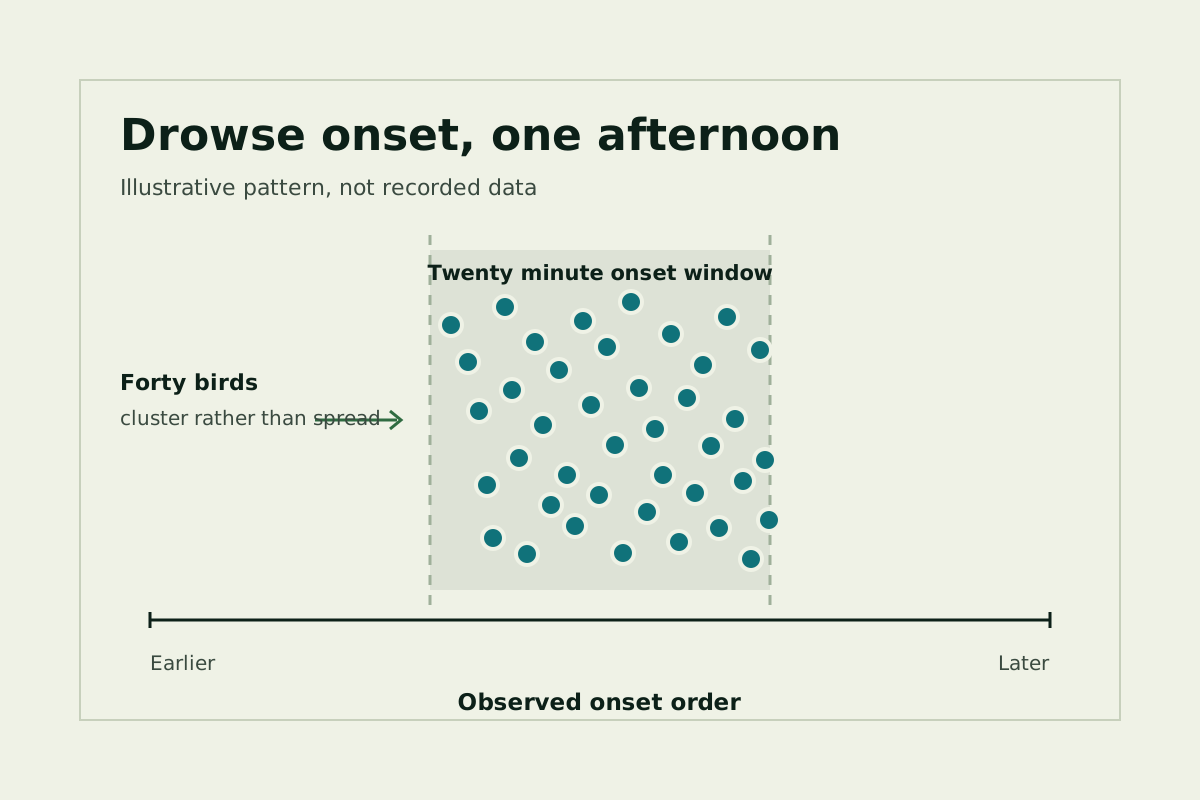
The population goes down together. Not at exactly the same moment, but inside a window of about twenty minutes, and the window is tight enough that it does not look like forty birds each making their own decision.
No vocalization has been recorded before onset. That was the first thing we looked for and the recordings are clean. Whatever is happening is not being announced.
What is still on the table
Light at a threshold. Onset tracks light intensity better than it tracks clock time, which is why the window moves through the season. It does not explain the tightness. Light falls across the whole range at once, so a threshold should produce onset spread across several minutes rather than clustered.
Temperature. Weaker than light, and the building holds temperature so evenly that there is not much signal to work with.
A visual cue from dominant birds. The most satisfying explanation and the hardest to test. Position in the range correlates weakly with onset order, but the birds that go down first are not consistently the same birds.
Nothing at all. Every bird ate at the same time, from the same tables, and reaches the same physiological state after the same interval. This explains the tightness of the window better than anything else and is deeply unsatisfying, because it means the most striking thing about this species is a coincidence of catering.
Why it matters beyond the building
Synchronized torpor in a group is not well described. If these birds are doing it without communicating, that is worth knowing. If they are communicating in some way we have not thought to record, that is worth more.
Six seasons of data. No answer.
Half asleep
Drowsebirds sleep one hemisphere at a time in the hour before full torpor, and then appear to stop. We are not certain whether they stop or whether we stop being able to see it.
Since 2018
- What is measured
- Eye closure and head orientation at one second intervals through the hour before onset and the ninety minutes after it, cross-referenced against position on the edge or the interior of a roosting group.
- What is still unknown
- Whether the second hemisphere goes down during full torpor, or whether the recording method loses resolution at exactly the point the question gets interesting.
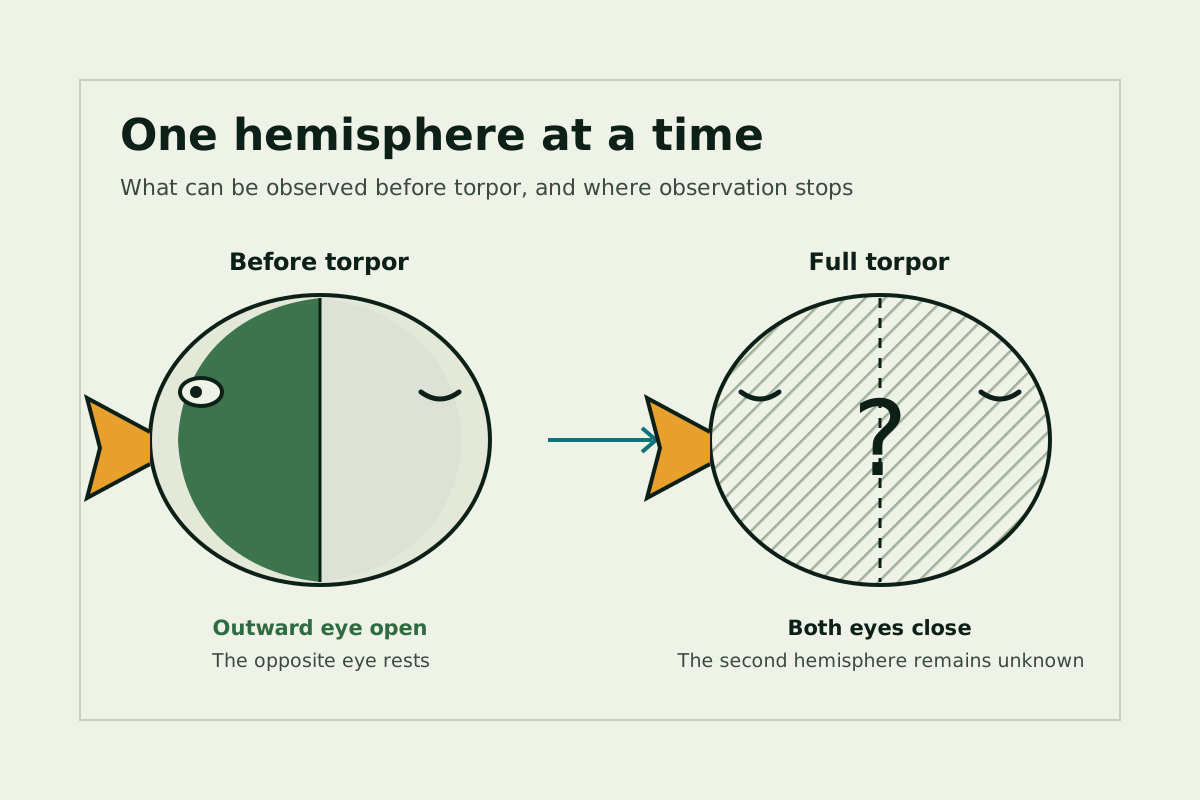
A lot of birds sleep one half of the brain at a time. The open eye faces outward, toward the edge of the group and whatever might arrive from that direction. It is a good arrangement and it is common.
Drowsebirds do it in the hour before torpor. The birds on the outside of a roosting group keep the outward eye open, the birds in the middle do not bother, and the pattern is consistent enough to be boring.
Then torpor starts and the pattern goes away.
The problem
Once a bird is fully down, both eyes are closed and the head is tucked. Under those conditions our method, which is watching, stops producing data. The question of what the second hemisphere is doing becomes a question we have no instrument for.
This matters more than it sounds. If both hemispheres go down, these birds are fully unconscious, in an open canopy, in a group, for ninety minutes a day. That is not a small claim. Wild populations of this species do not exist to compare against, and a captive population inside a building with a locked door is exactly the population you would expect to lose the behaviour, because nothing in here has come for them in seventeen years.
So the honest position is that we have two explanations and no way to separate them, and the interesting one is also the one that would be least surprising in a room with no predators.
What would settle it
Nothing we are currently willing to do. The methods that would answer this require handling birds during torpor, and handling a bird during torpor is trivially easy and probably harmful, which is a bad combination. We have chosen not to.
Flowering to feeding
A weekly record of what is in bloom against what the birds actually feed on, kept since 2011, because there is no reference for a canopy that assembled itself.
Since 2011
- What is measured
- What is flowering in each part of the range each week, and which of it the birds visit. Fifteen years of weekly entries, kept on paper first and transcribed.
- What is still unknown
- How much of the schedule is the plants and how much is us. The collection has been planted against the record for a decade, so the record is now partly a record of our own decisions.

Nobody planted the canopy. It arrived through a hole in the roof between 1981 and 2009 and it is made of whatever could get in, survive a British winter under glass with no heating, and outgrow everything else.
That means there is no planting plan to consult and no comparable site to compare against. If you want to know what will be flowering in the third week of February, the only way to find out is to have written it down for enough Februaries.
Why it is kept
The birds need nectar year round. A gap of three weeks in the flowering sequence is a gap in the food supply, and the way you close it is by planting something that flowers in that gap, which means knowing precisely where the gap is.
Fifteen years in, the record does that job well. We know the two thin weeks, in early February and again in late October, and both have been planted against.
The part that has become a problem
The record was supposed to describe the building. It now partly describes us.
Every year since about 2014 we have planted against the previous year’s chart, which means the flowering sequence is no longer the sequence a self-assembled canopy produces. It is the sequence a self-assembled canopy produces after fifteen years of somebody quietly filling in the holes.
We do not think this is avoidable and we would make the same decision again, because the alternative is birds with nothing to eat in February. It is worth being clear about, though, particularly for anyone who wants to use the record as a baseline. It is not a baseline. It is a management log that started out as a baseline.
Roost timing under amber light
Lantern Hours is the experiment. Roost entry, waking time and body mass are recorded across lit and unlit evenings to confirm the lighting is doing no harm.
Since 2019
- What is measured
- Roost entry time, next-morning waking time and weekly body mass, compared between evenings the building is lit for visitors and evenings it is not. Every week of every season since 2019.
- What is still unknown
- Whether the small delay in roost entry we see on lit evenings matters. It is consistent, it is about four minutes, and four minutes is either nothing or the first four minutes of something.

Running a public event in a building full of roosting birds is a decision that needs defending, so the event is also the study.
The lighting is specified backwards. Under 2200 kelvin, low, shielded, pointed down, at the lowest level people can still walk safely by. Every one of those constraints comes from what the roost needs, and the visitor experience is whatever is left over once they are satisfied.
What is measured
Roost entry time, waking time the following morning, and body mass weekly. Lantern evenings are Friday and Saturday from May to September, so every lit evening has unlit evenings on either side of it in the same week, under the same weather, with the same birds. That is a better comparison than we had any right to expect.
What we have found
Roost entry runs about four minutes later on lit evenings. It is consistent across seven seasons. Waking time is unchanged. Body mass is unchanged.
Four minutes is small. It is also not zero, and we have not decided what it means, so the honest summary is that the lighting has a measurable effect on behaviour and no measurable effect on anything we know how to connect to welfare.
The season it went wrong
In 2022 we replaced two failed fittings with units that were the same colour temperature on the box and were not. Roost entry moved by nineteen minutes within a fortnight and body mass in the affected part of the range started to drop.
The event was suspended for the rest of that season. The fittings went back, the numbers returned to normal within three weeks, and every unit is now metered on arrival rather than trusted.
That season is published in full alongside the others. A venue that only publishes the years it got it right is not publishing anything.